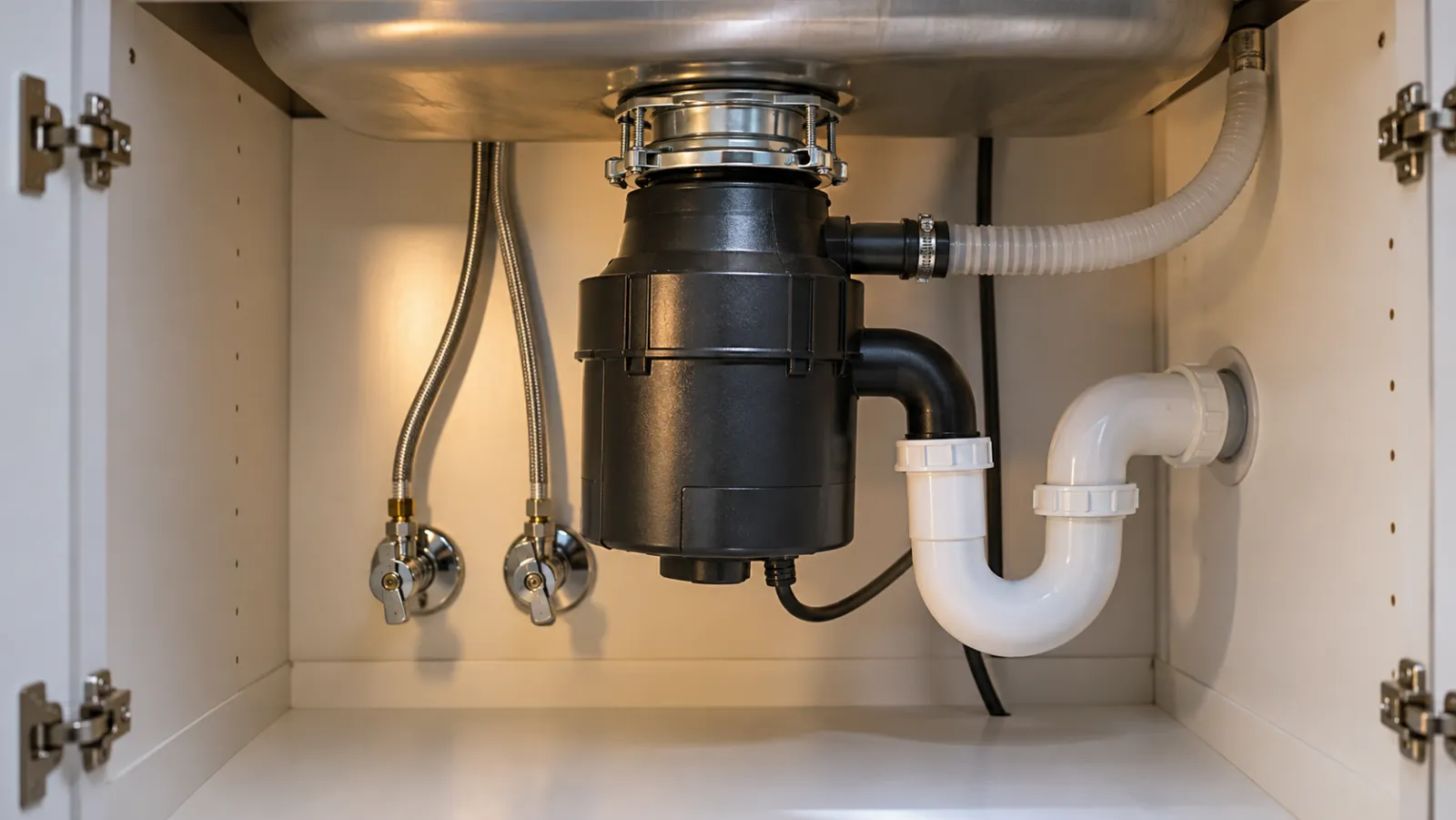
A garbage disposal that hums, won't turn on, or leaves the sink full of water is one of the most common calls we get. The good news: a lot of disposal problems can be fixed in five minutes with no tools beyond a flashlight and an Allen wrench. Here's what to try first, and how to tell when it's really time for a repair or a new unit.
First: Stay Safe
Before you do anything, turn the disposal off at the wall switch. If you're going to reach anywhere near the opening, unplug the unit under the sink or switch off its breaker too. Never put your hand inside a disposal, even when it's off. Use tongs or pliers to pull anything out.
And skip the chemical drain cleaner. It can damage the disposal's seals and plastic parts, it rarely clears a disposal clog, and it leaves caustic water sitting in the sink for whoever works on it next.
Fix 1: Press the Reset Button
Symptom: nothing happens when you flip the switch. No hum, no sound at all.
Most disposals have a small red or black reset button on the bottom of the unit. When the motor overheats or gets overloaded, it trips like a circuit breaker. Wait a few minutes for it to cool, press the button firmly until it clicks, then try the switch again.
If it trips again right away, something is jammed (see Fix 3). If it trips every few days, the motor is wearing out.
Fix 2: Check the Power
Symptom: still silent after a reset.
Check the breaker panel for a tripped breaker. Look under the sink to make sure the disposal is plugged in, since it's easy to knock the plug loose when you're storing things under there. Some kitchens wire the disposal to a GFCI outlet that can trip too. If the breaker and outlet are fine and the unit is still dead, the switch or the motor has likely failed, and that's a call for a plumber.
Fix 3: Free a Jam with an Allen Wrench
Symptom: the disposal hums but doesn't spin.
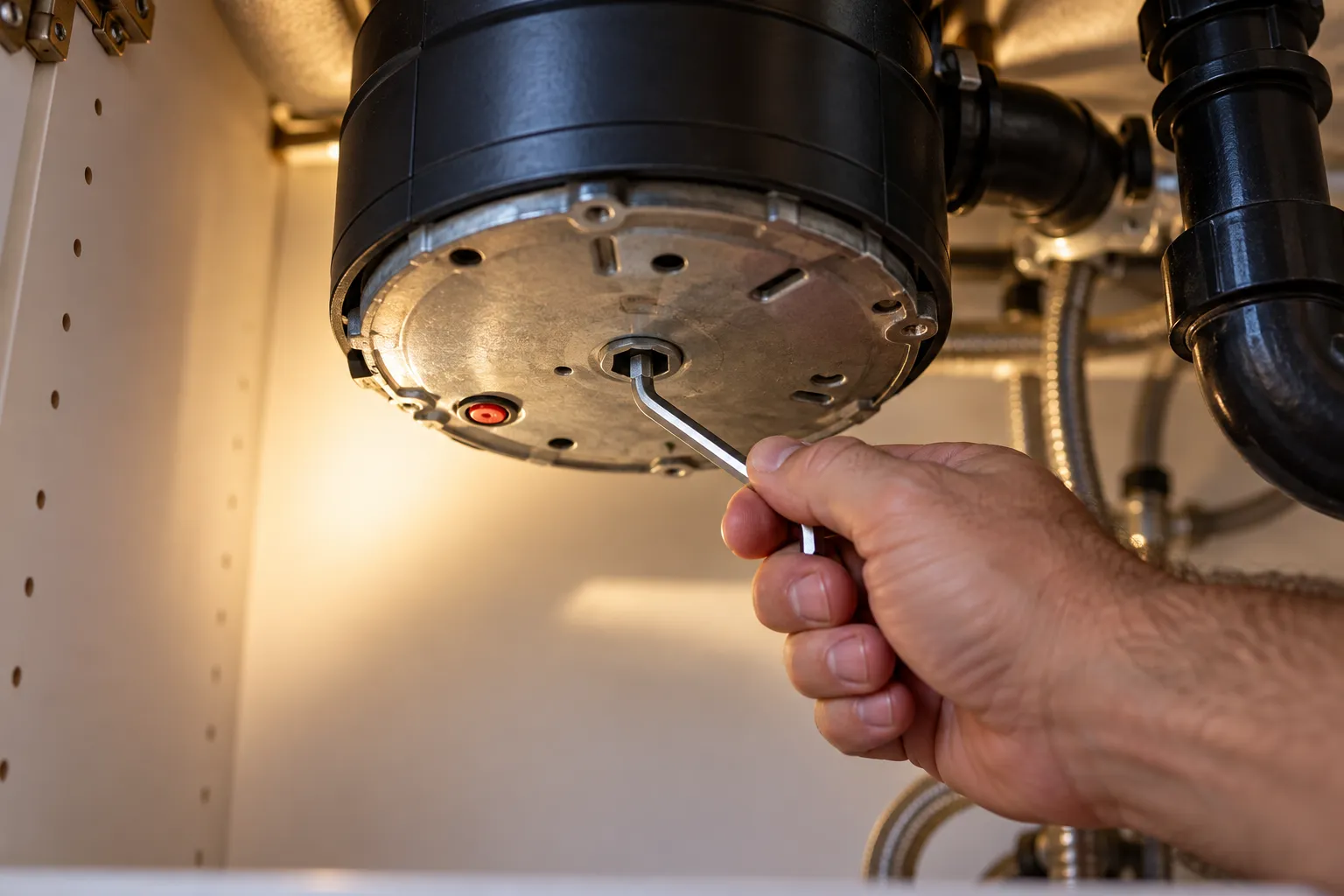
A hum means power is reaching the motor but the grinding plate can't turn. Something hard is wedged inside, like a fruit pit, a bottle cap or a piece of bone.
- Turn off the switch and unplug the unit.
- Find the small hex-shaped socket in the center of the bottom of the disposal.
- Insert a 1/4-inch Allen wrench (many disposals came with one) and work it back and forth until it turns a full circle freely.
- Use a flashlight and tongs to remove whatever was causing the jam.
- Plug it back in, press the reset button, run cold water and try it.
Don't keep flipping the switch on a humming disposal. Running a jammed motor is how motors burn out.
Fix 4: Clear a Slow Drain
Symptom: the disposal runs, but water backs up in the sink.
The clog is usually just past the disposal, in the drain line or the P-trap under the sink. Grease, rice, pasta and coffee grounds are the usual culprits. Try running the disposal with a strong flow of cold water for 30 seconds. If you have a double sink and only one side drains, use a plunger on the side without the disposal while you hold a wet rag over the other drain.
If the water still won't go down, the clog is further into the line. That's a job for professional drain cleaning, not more plunging. Our post on what not to put in a garbage disposal covers how to keep it from coming back.
Fix 5: Find Where the Leak Is Coming From
Symptom: water under the sink.
Dry everything off, put a paper towel under the disposal, run some water with a little food coloring in it and watch where the drip starts. Where it leaks tells you what to do:
- At the top, where the disposal meets the sink: the sink flange seal has loosened. It can be resealed.
- At the side, where the dishwasher hose connects: often just a loose clamp. Tighten it.
- At the drain pipe on the side: the connection or its gasket needs attention. Usually a quick repair.
- From the bottom or the body of the unit: the internal seals have failed. This can't be fixed. The disposal needs to be replaced.
Repair or Replace?
Most disposals last about 8 to 15 years, depending on the model and how hard it's worked. It usually makes sense to repair when the problem is a jam, a tripped reset, a loose connection or a flange leak on a unit that's otherwise in good shape.
It usually makes sense to replace when:
- It's leaking from the body of the unit
- The housing is rusted or corroded
- It keeps tripping the reset button or jams constantly
- It's more than about 10 years old and grinding poorly, or getting noticeably louder
- The motor is dead
A new disposal is also a chance to upgrade. Models with more horsepower and sound insulation grind better and are much quieter than a basic builder-grade unit.
When to Call a Plumber
Call us if you've tried the steps above and it's still not working, if the leak is coming from the unit itself, or if the sink keeps backing up. Believe Plumbing repairs and replaces garbage disposals throughout Tampa Bay, including Tampa, Carrollwood, Westchase and Brandon. We'll tell you honestly whether a repair makes sense or a new unit is the better value, and the estimate is free.
See our garbage disposal repair and installation services or contact us.
Need a Plumber in Tampa Bay?
Believe Plumbing is available 24/7 for emergencies and offers free estimates on all services.